What should I look for when booking a luxury African safari?
When booking a luxury African safari, look beyond the room and compare the quality of guiding, wildlife location,…
Read article
Travel Guide
Johannesburg is better known for business, aviation connections and urban South Africa than for wildlife, yet it is also one of the most useful gateways for travelers who want to fit a Big Five safari into…
Johannesburg is better known for business, aviation connections and urban South Africa than for wildlife, yet it is also one of the most useful gateways for travelers who want to fit a Big Five safari into a short South African itinerary. You do not need to fly directly from Johannesburg into the far reaches of Kruger National Park to experience lions, elephants, buffaloes, rhinoceroses and leopards. Several reserves within road-trip distance make it possible to leave the city in the morning and be watching African wildlife by the afternoon.
This makes Johannesburg unusually convenient for travelers with limited time. Someone attending a conference may have only one spare weekend. A family visiting relatives may want two nights in the bush before flying home. A traveler connecting through OR Tambo International Airport may be able to add a short safari without rebuilding an entire itinerary. In each of these situations, a short safari near Johannesburg can make far more sense than adding domestic flights and complicated transfers.
The two strongest names for genuine short Big Five trips are Pilanesberg National Park and Dinokeng Game Reserve. Pilanesberg provides a broad, established safari landscape near Sun City, while Dinokeng has the extraordinary distinction of being Gauteng’s only Big Five game reserve and lies close enough to Pretoria for very short bush escapes. Dinokeng’s own official information describes the reserve as malaria-free, approximately 40 minutes from Pretoria, and home to the Big Five.
These are not substitutes for a week in Greater Kruger, nor should they be judged as though they are. Their greatest strength is accessibility. When a traveler has only one, two or three days, the ability to reach a serious wildlife destination by road changes what is possible.
The phrase “safari near Johannesburg” can be misleading because many wildlife attractions advertise proximity to the city while offering very different experiences. Some are genuine free-ranging game reserves with large landscapes and functioning predator ecosystems. Others are wildlife parks, rehabilitation centers or smaller properties where the experience is not comparable to a conventional safari.
If the goal is a real Big Five safari from Johannesburg, several questions should be asked. How large is the reserve? Are the animals living within a broader natural ecosystem? Can visitors undertake proper game drives? Are self-drive routes available? Can you stay overnight inside or directly adjacent to the wildlife area? Is the reserve malaria-free? How much time will the transfer consume relative to the safari itself? Pilanesberg and Dinokeng stand out because they answer many of these questions well while remaining practical for short trips.
For many international visitors, Pilanesberg National Park is the obvious first choice when looking for the best Big Five safari near Johannesburg. It is a substantial wildlife destination rather than a small urban game park, offers Big Five possibilities, supports self-driving and guided game drives, and sits close to Sun City. Its landscape is also distinctive. Pilanesberg occupies an ancient volcanic environment, which gives the terrain a ring of hills, valleys, open grassland and waterholes. This creates a very different visual experience from the flatter lowveld landscapes associated with parts of Kruger.
The park’s current visitor information confirms that self-driving is allowed and that most ordinary 2WD sedans can explore much of the road network, although higher clearance can be useful on poorer gravel sections. This independence is one reason Pilanesberg works so well for travelers on different budgets. A couple can rent a car and self-drive. A family can book a guided open-vehicle safari. A luxury traveler can stay at a high-end lodge and join professionally guided drives. The same park therefore supports a broad range of Johannesburg safari prices.
Time is the most important resource on a short safari. Imagine flying into Johannesburg and having only two nights available. Traveling to a remote reserve requiring a domestic flight can consume much of that period. Pilanesberg, by comparison, can be reached by road and immediately introduces the traveler to an authentic wildlife landscape. A one-night itinerary can include an afternoon game drive, dinner, an early-morning safari and departure after breakfast. Two nights provide a significantly better experience because they allow several game-viewing sessions and more room for unpredictable wildlife behavior.
This is important. Even in a Big Five reserve, animals do not appear on command. A lion may be invisible during the first afternoon but cross the road the next morning. Elephants may spend one day in woodland and appear around a waterhole the next. The longer you stay, the more opportunities you create. For this reason, a 2-day or 3-day Pilanesberg safari from Johannesburg is normally much better than a rushed day trip when the schedule permits.
Pilanesberg is known for the traditional Big Five: lion, leopard, elephant, rhinoceros and buffalo. Yet reducing the park to these five species would be a mistake. Giraffes, zebras, wildebeest, impala, kudu, hippos, crocodiles, hyenas, jackals and numerous bird species contribute enormously to the safari experience. A first-time visitor may arrive obsessed with lions but leave talking about an elephant herd or giraffes walking against the volcanic hills.
Leopard is generally the most difficult of the traditional Big Five to encounter because of its secretive behavior and excellent camouflage. Even in famous leopard destinations, sightings can never be guaranteed. This is why travelers should evaluate a Pilanesberg safari by the quality of the overall wildlife experience rather than whether every species was checked off in twenty-four hours.
Pilanesberg is widely used by travelers specifically seeking a malaria-free South Africa safari, although the park’s own current FAQ phrases the issue carefully, saying the area is not considered a high-malaria danger zone and still recommends sensible mosquito precautions such as repellent. This distinction is worth preserving in responsible travel content. Marketing language often describes Pilanesberg simply as malaria-free, but travelers with specific medical concerns should always seek professional health advice rather than treating a safari blog as medical guidance. From a practical family-travel perspective, Pilanesberg remains attractive because it is outside the major malaria concerns associated with some northeastern safari regions.
Pilanesberg offers several accommodation styles, from larger family-friendly lodges to more exclusive properties. Bakubung Bush Lodge is particularly convenient for travelers seeking a full-service lodge experience and structured activities. Other accommodation around the wider Pilanesberg area can provide different levels of luxury, privacy and family suitability. The correct choice depends on what the traveler values most. If the safari is only one night, location and activity timing matter enormously. If staying three nights, facilities such as pools, spa treatments or children’s activities become more relevant.
A honeymoon couple might prioritize a smaller, more intimate property. A family may value interconnecting rooms and child-friendly activities. This is why the “best lodge” is not automatically the most expensive one.
One of Pilanesberg’s greatest strengths is self-drive safari access. The park confirms that visitors may drive their own vehicles and that much of the park is accessible to ordinary 2WD cars.
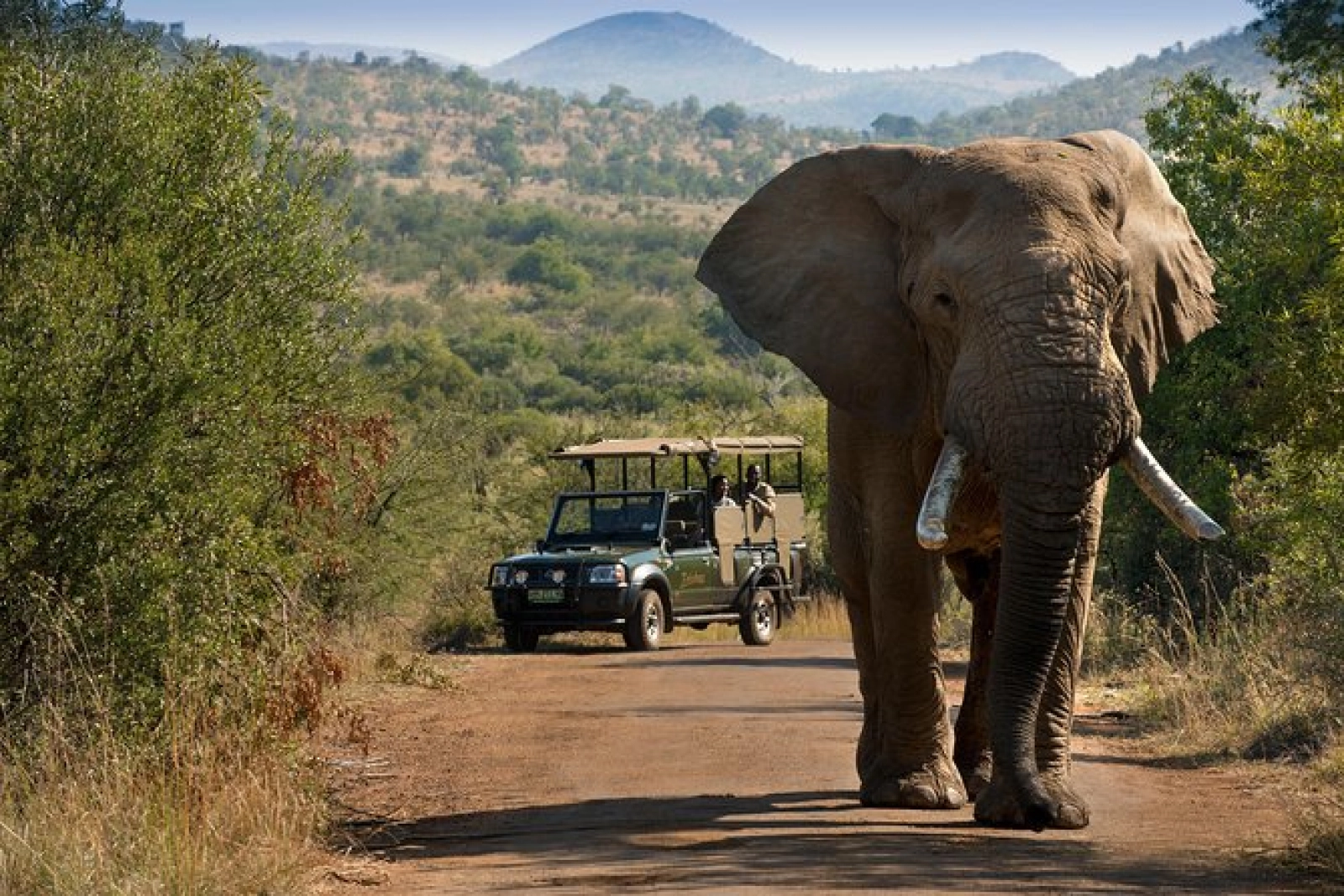
This can dramatically reduce the cost of a Johannesburg safari. You control departure times. You decide how long to remain at sightings. You can spend half an hour watching elephants without worrying about another guest’s priorities. However, self-driving also requires more patience and skill. A professional guide understands animal behavior, tracks and productive areas. A first-time traveler may drive directly past a leopard that a trained guide notices immediately. The best solution can be combining both styles: one professionally guided drive to learn the park and additional self-driving for independence.
A Pilanesberg day safari from Johannesburg is possible and popular, particularly for travelers with only a single free day. The main disadvantage is that a meaningful portion of the day is spent driving between Johannesburg and the park. The guest also misses the magical early-morning and evening hours enjoyed by overnight visitors. Still, when the choice is between no safari and a day safari, Pilanesberg is compelling. A full day can provide elephants, giraffes, antelopes, rhinos and possibly predators. The landscape itself gives visitors an authentic sense of the African bush. For business travelers or long layover-style itineraries, this may be the most practical safari option.
If proximity is the priority, Dinokeng Game Reserve deserves serious attention. The reserve’s official website identifies it as Gauteng’s only Big Five game reserve, approximately 40 minutes from Pretoria and malaria-free. That combination is extraordinary. Johannesburg and Pretoria form part of one of Africa’s largest urban regions, yet travelers can reach a genuine Big Five reserve without flying to another province. Dinokeng currently spans around 19,000 hectares according to the reserve’s own background information. It grew through cooperation between government and numerous private landowners, with internal property fences removed to create a larger connected wildlife landscape. Big Five species were progressively introduced, and the reserve officially opened in 2011.
This conservation history makes Dinokeng interesting for more than convenience. It represents an ambitious experiment in creating a functioning wildlife economy close to a major metropolis.
A Dinokeng weekend safari can be remarkably efficient. Leave Johannesburg or Pretoria after breakfast. Arrive around lunchtime. Check into a lodge or self-catering chalet. Spend the afternoon on a guided game drive. Wake early for another safari. Relax during the heat of the day. Then undertake another late-afternoon activity. By the end of two nights, you have experienced the full safari rhythm without an airport transfer or domestic flight. For travelers living in Johannesburg or visiting relatives in Gauteng, this convenience is difficult to beat.
Dinokeng is particularly interesting because it has a formal self-drive route. The reserve currently advertises more than 140 kilometers of self-drive tracks, most of which are suitable for sedan vehicles, along with picnic sites and bird hides. This makes Dinokeng one of the strongest choices for a budget Big Five safari near Johannesburg. Travelers can pay the applicable conservation and self-drive charges, stay in self-catering accommodation and explore much of the reserve independently.
Again, professional guiding still has advantages. Guided game drives help first-time visitors understand the ecosystem and can improve the chances of locating elusive wildlife. But the existence of self-drive infrastructure gives travelers valuable flexibility.
Dinokeng supports the traditional Big Five and a broader range of bushveld wildlife. The reserve’s official history notes the introduction of white rhino, lions and elephants during the development period, buffalo in 2012 and black rhino in 2018. A reserve close to Pretoria containing both black and white rhinos, lions, elephants and buffaloes challenges the assumption that serious safari requires traveling deep into a remote part of South Africa. Leopards remain naturally elusive, and no short safari should guarantee all five animals. The appeal is that the possibility exists within easy driving distance of Gauteng.
Dinokeng’s accommodation range is one of its strengths. The reserve itself highlights options ranging from campsites and self-catering chalets to luxury safari lodges. That variety allows very different travelers to use the same wildlife destination. A South African family can spend a relatively affordable weekend camping. A couple can book a private chalet. International honeymooners can select a boutique luxury lodge. For example, properties within Dinokeng include small luxury-style lodges offering guided Big Five drives, while others focus more heavily on family or self-catering accommodation. This flexibility makes Dinokeng particularly useful for travelers comparing budget and luxury safaris near Johannesburg.
This is the most useful comparison for short Johannesburg safaris.
Pilanesberg provides a larger, more established national-park-style experience with dramatic volcanic landscapes, extensive game-viewing infrastructure and a broad accommodation ecosystem connected with nearby Sun City. Dinokeng is much closer to Pretoria and extremely convenient from Gauteng. Its self-drive network, varied accommodation and Big Five status make it ideal for weekends or very short extensions. If a traveler has only one night and is based in Pretoria, Dinokeng may make more logistical sense.
If the traveler has two or three nights and wants a stronger “destination safari” feeling, Pilanesberg may be more compelling. Neither is universally superior. The correct choice depends on available time and the style of experience required.
No guide to safaris from Johannesburg can ignore Kruger. Kruger is one of the world’s great national parks and provides vastly more geographical scale than either Pilanesberg or Dinokeng. A serious Kruger safari can last a week and still explore only a portion of the park. But Kruger is not really “near Johannesburg” in the same short-safari sense. Road transfers are longer. Flying to nearby airports can make the journey efficient but adds cost.
For travelers with four or more nights dedicated specifically to safari, Kruger or the surrounding Greater Kruger private reserves may be worth the additional travel. For someone with only forty-eight hours, Pilanesberg or Dinokeng will usually use time more efficiently.
If the trip is primarily about safari and you have enough time, Kruger provides greater depth. More habitats. More roads. More accommodation choices. More time immersed in wilderness. Pilanesberg wins on convenience. A visitor can combine it easily with Johannesburg and Sun City. For a two-night safari, reducing transfer time may be more valuable than maximizing park size.
Sabi Sands belongs to another safari category entirely. It is famous for luxury private lodges, professional trackers and exceptional predator viewing, particularly leopards. It is also significantly more expensive and requires additional travel from Johannesburg. For a honeymooner wanting one of South Africa’s premier luxury safari experiences, Sabi Sands may justify the flight or long transfer. For someone attending a conference in Johannesburg with one free weekend, Dinokeng or Pilanesberg is much more practical.
There are smaller game reserves and wildlife properties around Gauteng and neighboring provinces, but travelers should distinguish carefully between a true Big Five reserve, a lodge on a broader reserve and a wildlife attraction. Marketing language can blur these categories. Before booking, verify whether the property actually lies within a reserve containing free-ranging Big Five species, whether game drives cover a substantial landscape and whether the experience is comparable to a conventional safari. This is especially important when a package appears unusually cheap or claims all five species can be “guaranteed.” Real safari does not guarantee wild animals.
Families often prefer malaria-free safari options near Johannesburg because they simplify trip planning. Pilanesberg is particularly strong because it combines family-friendly lodges, wildlife, road access and nearby Sun City. Dinokeng also offers several properties with family accommodation and self-catering facilities. The most important consideration is the child’s age. Very young children may not be allowed on all open-vehicle drives, and even when permitted, a three-hour game drive can be tiring. Families should therefore choose lodges with flexible activities rather than focusing only on animal lists.
Couples have more freedom.

A two-night romantic safari near Johannesburg can include afternoon drives, sundowners, private dinners and leisurely lodge time. Dinokeng works well for short escapes. Pilanesberg offers more of a destination-resort combination. Couples wanting high luxury may continue farther toward Greater Kruger, but the additional cost and travel should be justified by having enough nights.
For honeymooners spending a broader South African holiday in Cape Town and Johannesburg, adding a short Pilanesberg safari can be a practical way to include wildlife without introducing another flight. However, if safari is one of the honeymoon’s major priorities, it may be worth dedicating more time and traveling to a private reserve in Greater Kruger. The key is not assuming “luxury” automatically means “far away.” Premium lodge experiences can also be found around Pilanesberg and Dinokeng.
The cheapest genuine safari strategy is often self-drive. Rent a car. Drive to Pilanesberg or Dinokeng. Use modest accommodation. Explore independently. Join one guided game drive for expert interpretation. This can produce a satisfying budget Johannesburg safari without paying for a fully escorted private tour. The trade-off is responsibility. You manage navigation, gate times and your own game viewing. For first-time Africa visitors, a guided package may feel easier.
Luxury travelers can use Johannesburg as the gateway to a very different style of short safari. A private transfer or charter flight. Exclusive lodge. Private game-viewing vehicle. Spa. Fine dining. Professional guide and tracker. Premium accommodation. The price can rise substantially, but the experience also changes. Luxury is not simply a better room. It is often lower vehicle density, more personalized guiding and the ability to spend longer at sightings.
If one day is genuinely all you have, use it. A Johannesburg day safari will never provide the immersion of sleeping in the bush, but it can still create a remarkable wildlife experience. Pilanesberg is the classic option. Dinokeng may be even more convenient depending on starting location. Leave early. Spend as much daylight as possible inside the reserve. Return after the main game-viewing period. The biggest mistake would be spending half the day on unrelated stops rather than maximizing wildlife time.
One overnight transforms the experience. Suddenly you can be inside the wildlife area at sunrise. Predators may still be active. Temperatures are cooler. Bird activity increases. After the morning drive, you have breakfast instead of immediately beginning a long drive back to the city. A 2-day safari from Johannesburg is therefore the minimum duration we would recommend whenever the schedule allows.
Three days is where a short safari starts feeling like a real safari holiday. Two nights can provide an afternoon drive on arrival, morning and afternoon activities on the full day, and a final morning drive before departure. This creates multiple opportunities for wildlife and enough downtime to enjoy the lodge. For travelers deciding between a single long day and a 3-day Pilanesberg safari, the three-day version provides dramatically better value in terms of experience.
Both Pilanesberg and Dinokeng can be visited throughout the year.
The drier winter months generally produce thinner vegetation and can concentrate wildlife around water, while mornings can become cold. Summer brings warmer temperatures, greener landscapes and seasonal rainfall. Birding becomes especially attractive. Photographers may prefer green-season color and dramatic clouds. The ideal period depends on whether the traveler values easier large-mammal visibility or lush scenery.
South African winter mornings can surprise international travelers. Open safari vehicles create wind chill. Temperatures before sunrise can feel genuinely cold. Pack layers. A warm jacket, hat and gloves may be useful on the earliest drives. As the sun rises, conditions become much more comfortable. Winter vegetation can become dry and sparse, which often assists game viewing.
Summer produces a very different atmosphere. The bush becomes green. Birdlife expands. Temperatures rise. Afternoon thunderstorms can create spectacular skies. Young animals may be seen in some periods. The trade-off is denser vegetation and greater heat during the middle of the day.
Short safaris create pressure because travelers feel they must photograph everything immediately. Resist that instinct. Spend time watching. A lion sleeping beneath a tree may eventually stand. Elephants may cross the road. Giraffes may move into better light. Wildlife photography rewards patience even when the entire trip is only two days. A telephoto lens is valuable, but do not ignore wider landscapes. Pilanesberg’s hills and Dinokeng’s bushveld deserve context.
Both South Africa and the wider region face serious rhinoceros-conservation challenges. When travelers encounter rhinos, responsible behavior matters. Avoid publicly posting exact real-time locations. Do not pressure guides to approach too closely. Never judge the quality of a safari according to whether the vehicle got within meters of an animal. A responsible Big Five safari in South Africa prioritizes wildlife welfare and long-term conservation.
Guided drives are particularly valuable on very short safaris. A professional guide understands where animals have been moving, recognizes tracks and alarm calls, communicates with other guides where appropriate and interprets behavior. Self-driving gives independence and can reduce costs. The ideal compromise is often a combination. Join a guided drive at dawn or late afternoon. Self-drive during another session. This gives travelers both expertise and freedom.
Travelers without a rental vehicle can still reach safari destinations through organized transfers and tour packages.
This is where a private or small-group Johannesburg to Pilanesberg safari becomes valuable. The operator manages pickup, park access, accommodation and game drives. This style costs more than driving independently but removes logistical uncertainty, especially for first-time visitors.
Pilanesberg and Sun City form one of South Africa’s easiest safari-and-resort combinations. Families can spend part of the trip around wildlife and part enjoying resort facilities. The combination works especially well for travelers who want one holiday to satisfy very different interests. One family member wants elephants. Another wants pools. Another wants golf. A Pilanesberg–Sun City itinerary can accommodate all three.
A classic short South Africa itinerary might include Johannesburg, two or three nights in Pilanesberg and several nights in Cape Town. This gives the traveler urban history, wildlife, mountains, coastline, food and wine without excessive internal complexity. For first-time visitors with only ten days in South Africa, this can be more efficient than attempting Johannesburg, Kruger, Durban, Garden Route and Cape Town all at once.
Johannesburg is also one of Southern Africa’s major aviation hubs. Travelers can therefore combine a short safari with Victoria Falls, Botswana or other regional destinations. However, once the journey already includes Botswana or Zimbabwe wildlife areas, ask whether an additional Johannesburg safari is really necessary. Avoid duplicating the same experience merely to add destinations. Every safari day should serve a purpose.
Absolutely—if expectations are realistic. One or two nights will not provide the ecological depth of a ten-day Botswana journey or a week in Kruger. But a short safari can still produce life-changing moments. An elephant crossing the road. A lion roaring before sunrise. A rhino feeding quietly. A giraffe appearing behind an acacia. For someone who has never experienced African wildlife before, even twenty-four hours can create a powerful memory. The key is choosing a reserve that maximizes wildlife time rather than spending most of the trip in transit.
For many first-time international visitors, Pilanesberg National Park is the strongest general recommendation because it feels like a substantial destination safari and offers a broad range of accommodation and activities. Dinokeng becomes particularly attractive when proximity to Pretoria or Johannesburg is the dominant concern. Kruger becomes stronger when the traveler can dedicate several additional nights. Think of them as solutions to different time budgets.
The idea that a real South African safari must involve a long flight into a remote wilderness is simply not true. Johannesburg and Pretoria sit within practical reach of excellent wildlife areas. Pilanesberg National Park offers a classic Big Five safari landscape with self-driving, guided game drives, multiple accommodation levels and convenient access to Sun City. Dinokeng Game Reserve provides the remarkable experience of a genuine Big Five reserve within Gauteng itself, with self-drive routes, guided activities and accommodation ranging from campsites to luxury lodges. Its proximity to Pretoria makes it especially powerful for travelers whose biggest constraint is time.
Kruger and Greater Kruger remain better choices when safari is the primary purpose of the South African journey and several nights are available. But that is not the situation every traveler faces. Sometimes there are only two spare days. Sometimes the flight leaves Sunday evening. Sometimes the family wants safari without another domestic flight. Sometimes a conference finishes on Friday and Monday brings another commitment. In those situations, the best Big Five safari near Johannesburg is not necessarily the biggest or most famous reserve in South Africa.
It is the reserve that lets you spend the greatest proportion of your limited time watching wildlife rather than traveling toward it. And when the first elephant appears beside the road, or a lion lifts its head in the early morning light, the fact that Johannesburg is only a few hours away suddenly becomes irrelevant.
Get quick answers to the most common questions. If you still have questions, our safari experts are here to help.
Pilanesberg National Park is one of the strongest all-round options for a short safari, while Dinokeng is exceptionally convenient and is Gauteng’s only Big Five game reserve.
Dinokeng is among the closest genuine Big Five options in the Gauteng region and is roughly 40 minutes from Pretoria according to the reserve.
Yes. Pilanesberg is widely used for Big Five safaris and is one of the most established wildlife destinations accessible from Johannesburg.
Yes. The park’s current FAQ confirms that visitors can self-drive and that much of the park is suitable for normal 2WD vehicles.
Yes. Dinokeng currently advertises more than 140 kilometers of self-drive tracks.
The reserve describes itself as malaria-free.
Pilanesberg is commonly promoted as a low-malaria or malaria-free safari choice, although the park’s own FAQ says it is not a high-malaria danger area and advises standard mosquito precautions.
Yes. Pilanesberg and Dinokeng can both be considered for day trips, though staying overnight provides a better wildlife experience.
One night is enough for an introduction, but two nights creates far more game-viewing opportunities.
Kruger provides a much larger and deeper safari experience. Pilanesberg is more convenient for short trips from Johannesburg.
Dinokeng is extremely convenient from Gauteng; Pilanesberg generally feels more like a destination national-park safari. The better choice depends on available time.
Yes at many properties, but age restrictions and ranger policies vary. Families should confirm directly when booking.
No. Wildlife is wild. Any operator guaranteeing all five species should be treated cautiously.
Self-driving in Pilanesberg or Dinokeng with modest accommodation can be among the most economical approaches.
Premium lodges in Pilanesberg or Dinokeng can work for short trips, while travelers with more time may consider Greater Kruger private reserves.
Two nights is an excellent minimum for a short safari. Three nights provides a more relaxed experience.
Our safari experts are here to help you plan your safari. Get personalized advice, the latest information and a free, no-obligation quote.
We typically reply within a few hours.

Share This Article
When booking a luxury African safari, look beyond the room and compare the quality of guiding, wildlife location,…
Read article
The Great Migration in Africa happens all year because the herds continuously circulate through the Serengeti–Mara ecosystem in…
Read article
Definitive answer: A picnic lunch on safari is a packed or catered midday meal eaten at an approved…
Read article
Definitive answer: A bush dinner is an outdoor evening meal arranged in a safe safari setting away from…
Read articleLet us take you closer to the wildlife, people and places that make Africa extraordinary.
Plan Your Safari Today