Tipping in Zambia: Complete Safari, Walking Safari & Travel Tipping Guide
Understanding tipping in Zambia is particularly useful for safari travellers because Zambia is famous for highly personalised wilderness…
Read article
Travel Guide
Understanding tipping in Zimbabwe is particularly important for safari travellers because the country has one of southern Africa's strongest professional guiding traditions. A Zimbabwe safari may involve highly qualified professional guides, specialist trackers, walking safari teams, canoe guides, lodge employees, Victoria Falls activity staff and transfer drivers, sometimes within the same itinerary. The appropriate gratuity therefore depends much more on the type and duration of service than on one universal percentage.
Understanding tipping in Zimbabwe is particularly important for safari travellers because the country has one of southern Africa’s strongest professional guiding traditions. A Zimbabwe safari may involve highly qualified professional guides, specialist trackers, walking safari teams, canoe guides, lodge employees, Victoria Falls activity staff and transfer drivers, sometimes within the same itinerary. The appropriate gratuity therefore depends much more on the type and duration of service than on one universal percentage.
A traveller spending three nights at a lodge in Hwange National Park, four nights on a walking-focused safari in Mana Pools National Park and two nights at Victoria Falls may encounter three completely different guide teams. A traveller on a privately guided overland safari, however, may remain with the same professional guide for most of the journey. These two travellers should not necessarily budget for gratuities in exactly the same way.
The simplest approach is to separate the people providing specialist personal guiding from the wider hospitality team. Safari guides and trackers are generally tipped directly. Lodge employees are commonly recognised through a communal staff gratuity. Short-duration activity guides, transfer drivers and Victoria Falls excursion staff receive smaller service-specific gratuities.
Tipping is customary within Zimbabwe‘s tourism industry, but it should remain an acknowledgement of good service rather than a compulsory second price attached to your safari.
Tipping is widely appreciated at safari lodges, camps, restaurants, hotels and during guided activities. International safari guests are generally expected to be familiar with gratuities, particularly when they have received several days of personalised guiding.
That does not mean every person encountered during the trip needs to be tipped individually.
A well-run safari property may employ dozens of people. Guests naturally interact with professional guides, waiters and reception employees, while other important staff members work in kitchens, housekeeping, maintenance, laundry, stores and security.
Communal tipping systems help recognise this wider team.
Professional safari guides are usually considered separately because their service is highly personal and can extend over several days.
For professional safari guiding, approximately US$10–20 per guest per day is a useful broad planning benchmark after good service, although individual operators and premium properties may recommend different amounts.
For a couple, this might translate to approximately US$20–40 per day collectively.
Private specialist guiding, particularly walking-focused safaris, may justify a higher gratuity when the guide has provided exceptional service.
These amounts are guidelines rather than compulsory rates.
The most important consideration is whether a published recommendation is per guest, per couple or from the travelling party as a whole.
Zimbabwe has a longstanding reputation for rigorous professional safari guiding. This becomes especially apparent on walking safaris, where guests leave the physical protection of a vehicle and experience wildlife at ground level.
A professional guide needs far more than the ability to identify animals. They must understand behaviour, wind direction, tracks, warning signs, escape routes, terrain and how animals are likely to respond to people on foot.
On a vehicle safari, a guide can reposition the vehicle. During a walking safari, every approach requires careful judgement.
The best guides combine safety with interpretation. They may explain the difference between fresh and old elephant tracks, identify the alarm calls of birds and antelope, interpret lion spoor or demonstrate how seemingly insignificant plants contribute to the ecosystem.
These skills should be considered when deciding on a gratuity.
If one professional guide accompanies you for the entire safari, give the gratuity when your journey together ends.
If you move between camps and receive a new resident guide at each property, tip each guide before departing that camp.
For example, a guest might have one guide in Hwange and another in Mana Pools. These are separate guiding relationships and should normally be treated separately.
Some Zimbabwe safari operations use dedicated trackers who work alongside professional guides.
A skilled tracker reads signs that most visitors would not even notice: footprints, disturbed vegetation, dung, scent markings and subtle changes in animal behaviour.
Where a dedicated tracker has accompanied you consistently, approximately US$5–10 per guest per day is a useful general planning range.
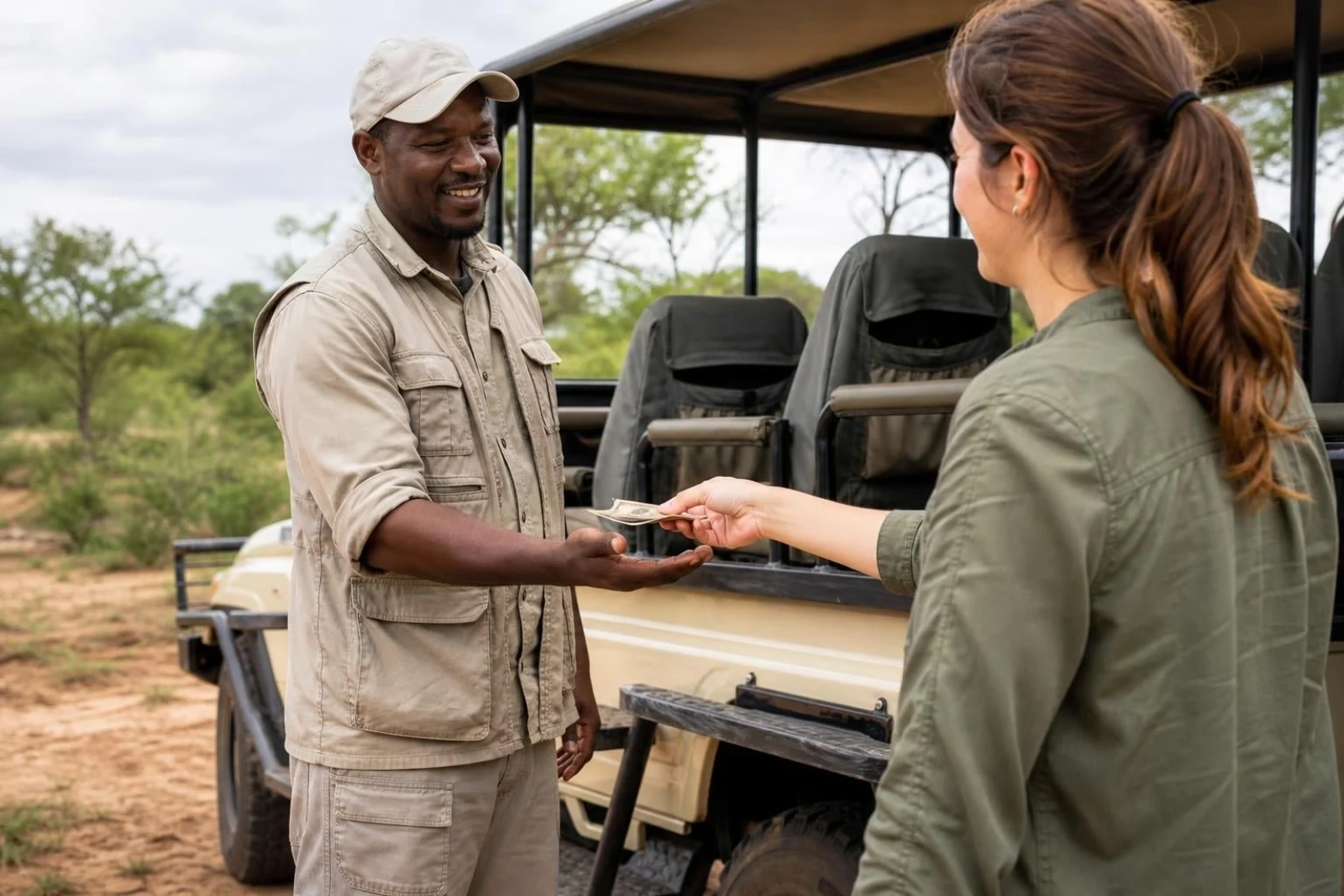
Ask whether trackers receive tips directly or share the guide gratuity.
Hwange National Park is Zimbabwe‘s largest national park and one of the country’s premier safari destinations.
Visitors may explore Hwange through vehicle game drives, walking safaris and visits to hides or waterholes.
If you have one resident guide throughout a three-night stay, tip that guide at the end of the stay.
General lodge staff should normally be recognised separately through the communal gratuity system.
Where a tracker accompanies your activities, ask whether that person should receive a separate gratuity.
Hwange is a natural ecosystem, not a zoo.
Wildlife concentrations change according to season, rainfall and water availability.
A guide cannot guarantee that a lion pride will appear beside your vehicle or that elephants will arrive at a particular waterhole during your visit.
Evaluate effort, interpretation, knowledge, safety and ethical guiding rather than creating a checklist of animals.
Mana Pools deserves special attention because walking safaris are central to the destination’s identity.
A Mana Pools guide may spend hours interpreting wildlife on foot, carefully reading elephant behaviour, following tracks or positioning guests responsibly near wildlife.
Walking safaris require constant judgement.
For excellent specialist guiding, travellers may reasonably tip toward the upper end of the normal safari-guide range or above it.
The gratuity should recognise expertise rather than the number of kilometres walked.
Where a specialist walking guide is separate from your regular safari guide, approximately US$10–20 per guest for a substantial half- or full-day private experience is a reasonable broad benchmark.
If your resident camp guide conducts both vehicle and walking activities throughout your stay, one end-of-stay gratuity is sufficient.
There is no need to tip after every individual walk.
Zimbabwe‘s Zambezi region also offers canoeing experiences.
A professional canoe guide carries significant responsibility for route selection, river conditions, wildlife awareness and guest safety.
For a substantial guided canoe excursion, approximately US$10–20 per guest per day can be used as a broad benchmark.
Multi-day canoe expeditions may involve additional support staff. Ask the operator how crew gratuities should be distributed.
The wider lodge team should not be forgotten.
A remote safari camp depends on chefs, waiters, housekeepers, maintenance personnel, laundry staff, managers, security employees and many others.
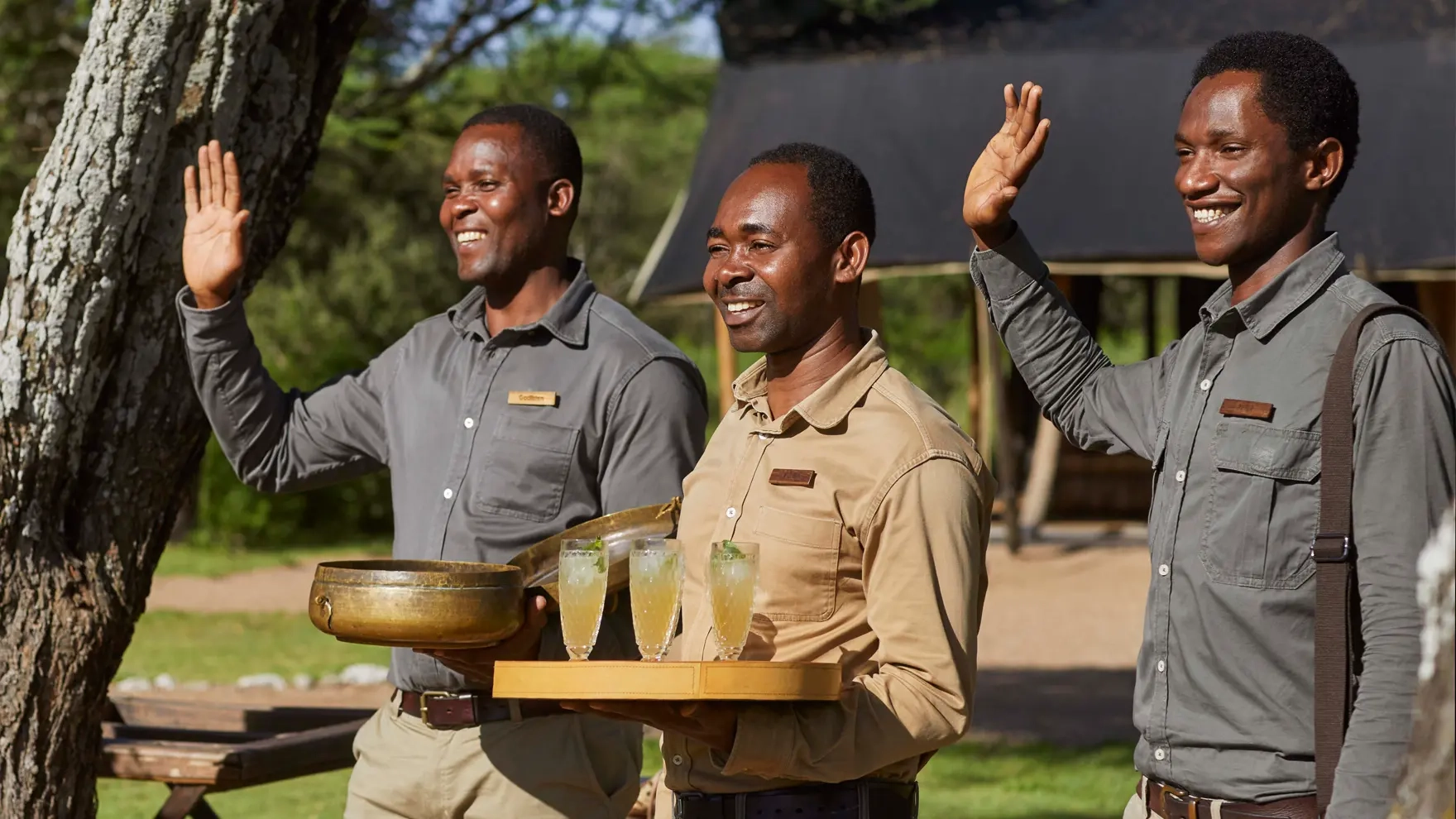
Approximately US$5–15 per guest per night can serve as a broad planning range for the communal staff gratuity.
Luxury properties may provide their own recommendations.
Where a communal gratuity box exists, use it rather than distributing money randomly among visible employees.
A waiter may spend considerable time speaking with guests, while the person maintaining a camp’s water system may never be seen.
Both contribute to the experience.
Communal tipping provides a more equitable method of recognising the whole hospitality team.
Professional guides and trackers may be excluded from this pool, so always ask.
Victoria Falls operates more like an activity and resort destination than a traditional safari camp.
Travellers may participate in guided waterfall tours, sunset cruises, helicopter flights, white-water rafting, cultural tours, game drives and numerous other activities.
Each activity may be operated by a different company.
You do not need to tip everyone you encounter.
Recognise the people who provide substantial personal service.
For a private or small-group guided tour of Victoria Falls, approximately US$5–10 per guest is a reasonable gratuity after informative, attentive guiding.
A guide who provides detailed interpretation of geology, history, ecology and local culture adds significantly more value than somebody who simply walks between viewpoints.
Sunset cruises may involve a captain, guide, waiters and other crew.
Where a communal crew gratuity system is available, use it.
Approximately US$5–10 per guest as a shared gratuity after a high-quality cruise is reasonable, although the amount remains discretionary.
Routine tipping of helicopter pilots is generally not necessary.
The flight is primarily a commercial aviation service.
Ground staff who provide substantial personal assistance may receive a modest gratuity, but travellers should not feel that the pilot automatically requires a percentage of an expensive flight.
Rafting guides carry significant responsibility for safety and instruction.
After a professionally conducted rafting experience, approximately US$5–15 per guest can be a reasonable gratuity.
If the excursion involves a larger support team, ask whether gratuities are pooled.
At restaurants in Victoria Falls, Harare and other tourist areas, approximately 5–10% is a practical benchmark for good table service when service has not already been included.
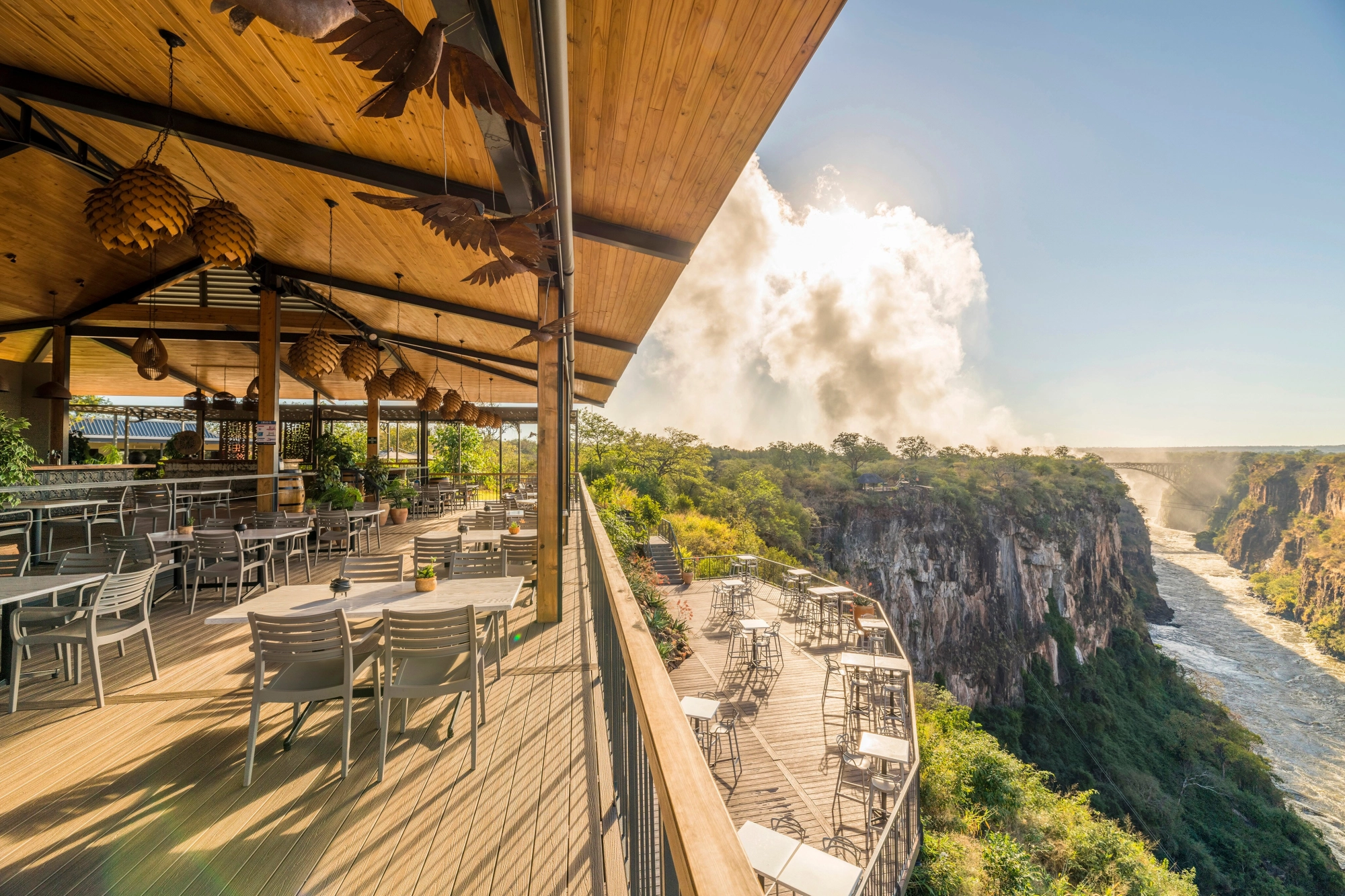
At higher-end establishments, approximately 10% is common.
Check the bill first.
If service has already been added, an additional gratuity is optional.
Zimbabwe‘s currency environment has changed repeatedly over time, so travellers should check the current monetary situation shortly before departure.
Within the international tourism industry, US dollars are extremely useful for gratuities and are widely understood at safari camps and in Victoria Falls.
Bring small denominations.
US$1, US$5, US$10 and US$20 notes are considerably more useful than carrying only US$50 or US$100 notes.
Cash is normally the easiest method for guides, trackers and activity staff.
Luxury lodges may allow guests to add a staff gratuity to their final account.
If paying by card, ask how the gratuity is distributed.
Do not assume that a card tip automatically reaches the individual guide you intend to recognise.
For luggage assistance at a Victoria Falls or Harare hotel, approximately US$1–3 is a reasonable small gratuity.
At safari camps where luggage assistance is part of a communal service system, separate porter tipping may be unnecessary.
At ordinary hotels without communal tipping, approximately US$2–5 per room per day can be a useful benchmark.
Leaving housekeeping tips daily may be preferable because different employees can service the room on different days.
At safari lodges, use the communal staff system where available.
For a straightforward airport transfer, approximately US$3–5 per vehicle is sufficient after good service.
For longer private transfers or significant waiting time, travellers may choose to give more.
Visitors frequently cross between Zimbabwe and Zambia or travel between Victoria Falls, Kasane and Botswana.
A cross-border transfer may involve one driver for the entire journey or different drivers on either side of the border.
You do not need to tip every person involved in a routine vehicle handover.
Focus on drivers who actually provide substantial service, assist with luggage and help manage border procedures.
Cultural experiences should be approached respectfully.
Where a recognised community guide spends meaningful time explaining local history, livelihoods or traditions, a gratuity is appropriate.
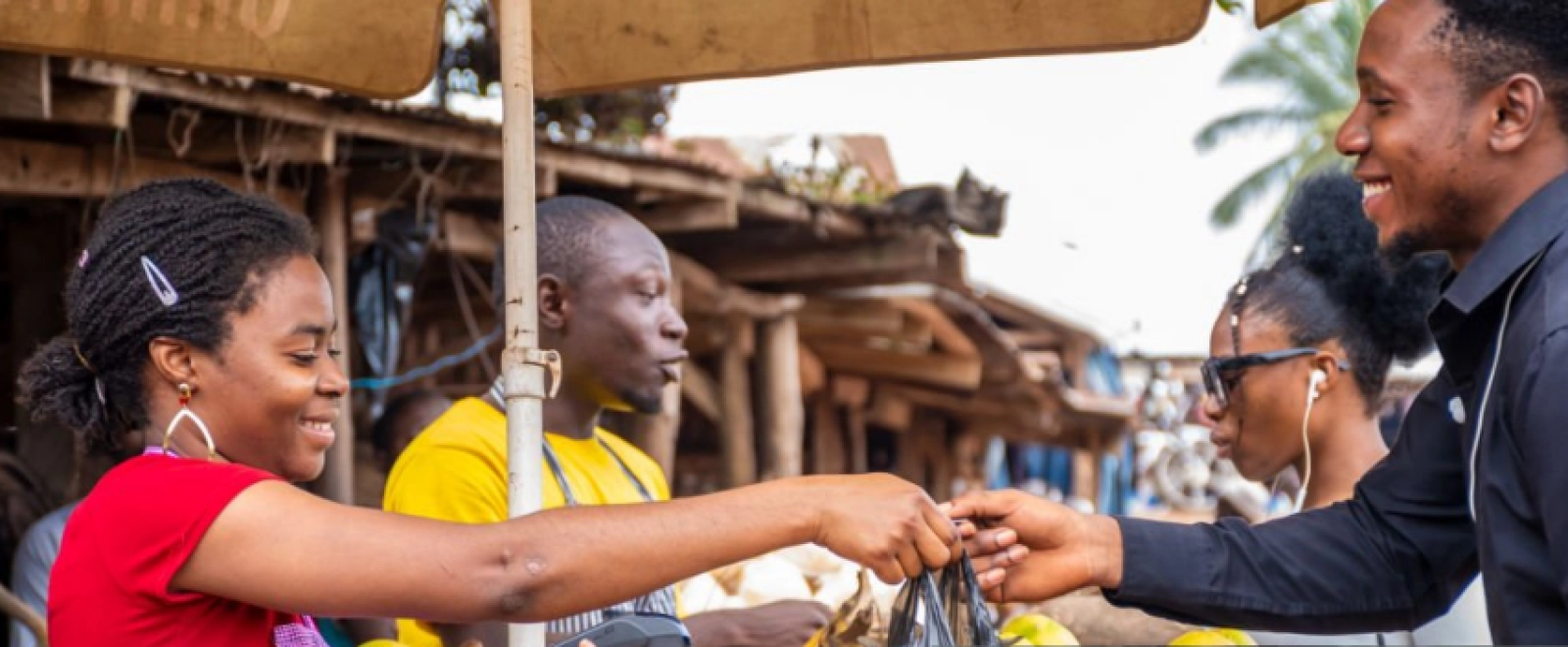
Avoid distributing money randomly to children.
Support legitimate community tourism programmes and purchase locally produced crafts where appropriate.
| Service | Practical Planning Guideline |
|---|---|
| Professional safari guide | Around US$10–20 per guest/day |
| Couple’s guide | Around US$20–40/day collectively |
| Tracker | Around US$5–10 per guest/day |
| Lodge/camp staff | Around US$5–15 per guest/night |
| Specialist walking guide | Around US$10–20 per guest/activity |
| Canoe guide | Around US$10–20 per guest/day |
| Victoria Falls private guide | Around US$5–10 per guest |
| Sunset cruise crew | Around US$5–10 per guest collectively |
| Rafting guide | Around US$5–15 per guest |
| Restaurant | Around 5–10% |
| Hotel porter | Around US$1–3 |
| Housekeeping | Around US$2–5 per room/day |
| Airport transfer | Around US$3–5 per vehicle |
| Helicopter pilot | Routine tip generally unnecessary |
These are planning benchmarks, not mandatory Zimbabwean gratuity rates.
Imagine a couple spending three nights in Hwange, three nights in Mana Pools and one night at Victoria Falls.
They have different resident guides in Hwange and Mana Pools.
If they allocate approximately US$30 per day collectively for professional guiding, they might spend around US$180 on safari-guide gratuities across six guided days.
If they allocate approximately US$15 per night collectively to lodge staff, they might spend another US$90–105.
Trackers and specialist activities might add US$50–100.
Their overall safari gratuity allowance might therefore be approximately US$350–450, depending on services and satisfaction.
This is an example, not a required amount.
A visitor spending two nights at Victoria Falls might tip very differently.
They may give US$5–10 to a private Falls guide, a shared gratuity after a sunset cruise, US$3–5 for an airport transfer and ordinary restaurant gratuities.
There is no reason to apply a multi-day safari-guide rate to every day spent at Victoria Falls.
High accommodation prices should not automatically translate into percentage-based gratuities.
If a luxury safari camp costs more than US$1,000 per person per night, guests are not expected to calculate 10% of the room price as a tip.
Use daily service-based benchmarks.
Ask the property about its guide, tracker and staff gratuity systems.
Large groups should clarify whether recommended gratuities are per guest or collectively from the travelling party.
A family using one private guide should consider the overall service provided rather than blindly multiplying every recommendation.
Tip safari guides and trackers when leaving the camp or when your time together ends.
Place general lodge gratuities in the communal box at checkout.
Tip Victoria Falls activity guides after their activity.
Restaurant gratuities are given when settling the bill.
Published figures should never be treated as maximums.

If your guide has delivered extraordinary interpretation, handled a difficult situation professionally or made an exceptional contribution to your safari, you are free to give more.
Gratuities remain discretionary.
Reduce or omit the tip when service has genuinely failed to meet reasonable standards.
Report serious safety or professional concerns to management or the safari operator.
Never offer a larger gratuity in exchange for approaching elephants dangerously closely, leaving authorised roads where prohibited, disturbing predators or ignoring national park regulations.
A professional guide who refuses such requests is demonstrating exactly the behaviour responsible travellers should value.
Tipping in Zimbabwe should primarily recognise expertise and service. This is particularly important in a country where professional guiding, walking safaris and specialist tracking can form such an important part of the travel experience.
Budget separately for your professional guide, tracker and general lodge team. At Victoria Falls, move to smaller activity-specific gratuities for guides, cruises, rafting and transfers. Carry small US-dollar notes and clarify how each camp distributes its staff gratuities.
Most importantly, reward professionalism, conservation ethics, safety and interpretation rather than simply counting wildlife sightings.
Done thoughtfully, a gratuity becomes a straightforward acknowledgement of the people whose skill and hospitality helped transform a Zimbabwe holiday into an exceptional safari experience.
Get quick answers to the most common questions. If you still have questions, our safari experts are here to help.
Yes, especially in tourism, safari lodges, hotels and restaurants.
Approximately US$10–20 per guest per day is a useful broad planning benchmark.
Approximately US$20–40 per day collectively can be a practical range.
Often yes, unless the lodge combines guide and tracker gratuities.
Approximately US$5–15 per guest per night through the communal system is a useful benchmark.
Yes. Specialist walking guiding deserves recognition, particularly where the guide provides extensive private interpretation.
Guided activities, cruises and transfers can receive modest service-specific gratuities.
Routine pilot tipping is generally unnecessary.
Yes, a modest gratuity is appropriate after good professional service.
Yes. Small US-dollar denominations are particularly useful within Zimbabwe‘s tourism sector.
Approximately 5–10% is appropriate for good service where service has not already been included.
At the end of your time together.
Usually not unless your itinerary specifically states that gratuities are included.
Recognise the distinction between professional guides, trackers, general lodge staff and short-duration activity guides, and tip each category according to the service actually received.
Our safari experts are here to help you plan your safari. Get personalized advice, the latest information and a free, no-obligation quote.
We typically reply within a few hours.

Share This Article
Understanding tipping in Zambia is particularly useful for safari travellers because Zambia is famous for highly personalised wilderness…
Read article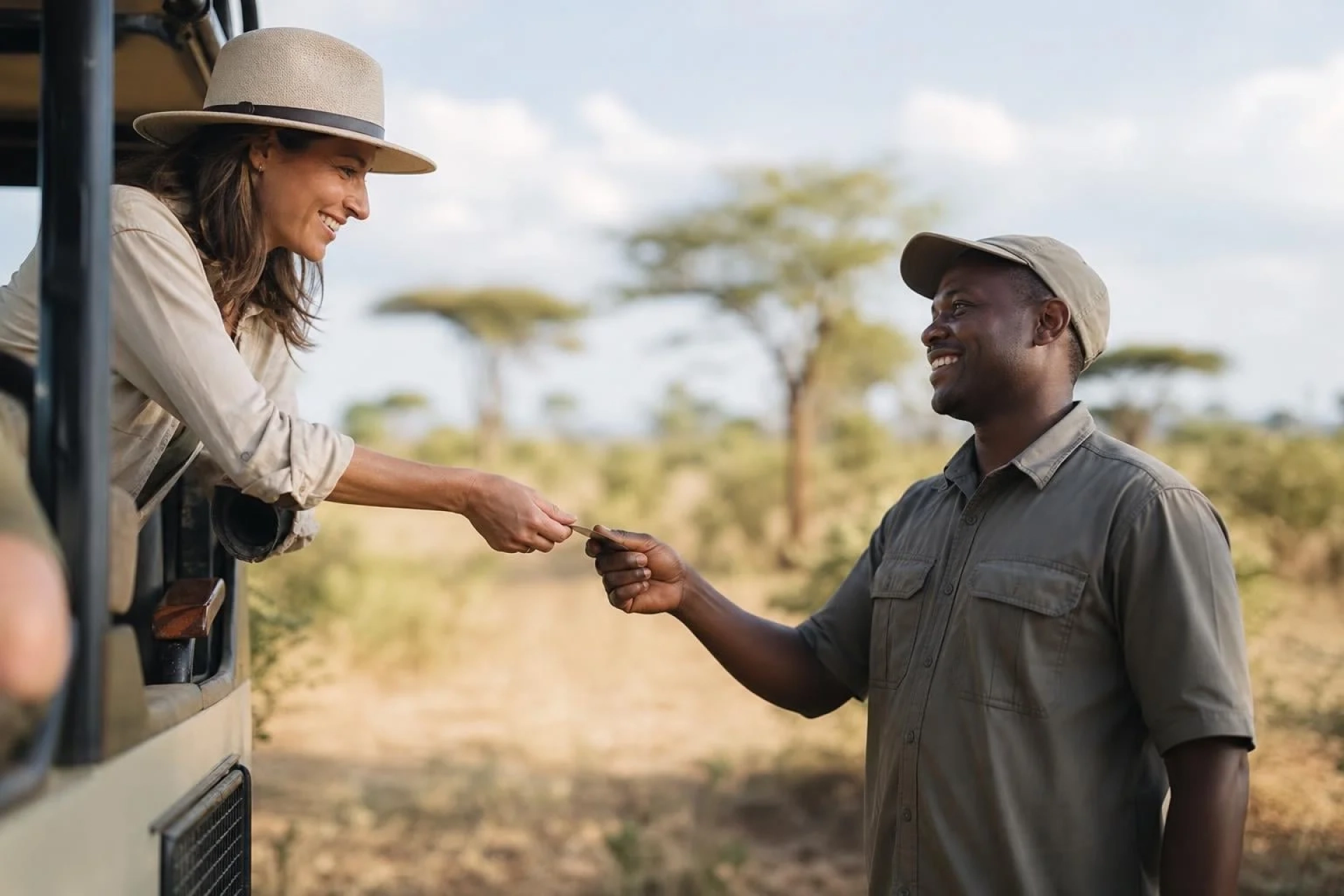
Tipping in Namibia differs subtly from tipping in many other major African safari destinations because a significant proportion…
Read article
Tipping in Botswana is relatively easy once travellers understand how the country's safari industry operates. Unlike many East…
Read article
Understanding tipping in Tanzania requires more than knowing how much to give a safari driver. Tanzania offers an…
Read articleLet us take you closer to the wildlife, people and places that make Africa extraordinary.
Plan Your Safari Today