The major advantage of cultural
The major advantage of cultural tourism around Nyungwe is the contrast between wilderness and community life.


A cultural safari in Nyungwe National Park adds an important human dimension to one of Rwanda's most celebrated rainforest destinations. Nyungwe is internationally known for its ancient montane forest, remarkable biodiversity, chimpanzee trekking, colobus monkey tracking, birdwatching and scenic forest walks.
A cultural safari in Nyungwe National Park adds an important human dimension to one of Rwanda's most celebrated rainforest destinations. Nyungwe is internationally known for its ancient montane forest, remarkable biodiversity, chimpanzee trekking, colobus monkey tracking, birdwatching and scenic forest walks. Yet the landscapes surrounding the protected forest are also home to farming communities, tea growers, artisans and families whose histories are closely connected with the forests and fertile highlands of southwestern Rwanda.
For many travelers, Nyungwe National Park is primarily associated with primate adventures. Visitors often arrive specifically to track chimpanzees, walk beneath the forest canopy or search for endemic birds. Including community and cultural experiences before or after these activities creates a much more complete understanding of the region.
The forest does not exist in isolation. Communities cultivate tea and food crops close to its boundaries, local guides provide tourism services, artisans preserve traditional skills and conservation initiatives increasingly connect the protection of biodiversity with sustainable livelihoods.
A well-designed Nyungwe cultural safari therefore combines Rwanda's extraordinary natural heritage with authentic opportunities to understand local traditions, agriculture, food, crafts and everyday rural life.
Plan Your Cultural Safari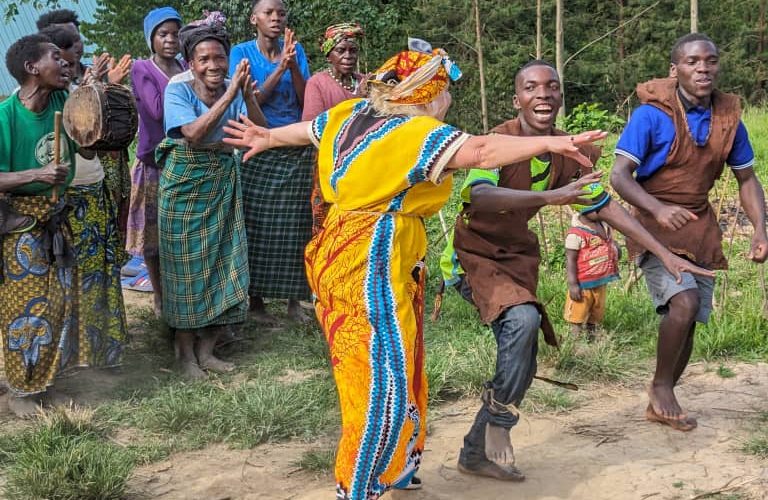
A traditional Rwandan food experience provides one of the most engaging ways to learn about rural culture near Nyungwe.
Meals can include beans, bananas, potatoes, cassava, vegetables and other locally grown ingredients.
Songs have historically played roles in ceremonies, celebrations, storytelling and social gatherings.
Drumming creates an especially powerful atmosphere.
A cultural safari in Nyungwe National Park can include several complementary experiences. Exact programmes vary by community partner — responsible arrangements emphasise genuine interaction.
Several communities live around the wider Nyungwe landscape. Daily life commonly revolves around farming, small-scale trade, livestock, tea production and community institutions. Guided walks through rural areas can introduce visitors to homes, farms, schools, churches and village businesses.
One of the most visually striking features surrounding the forest is the presence of vast Rwanda tea plantations. Perfectly arranged rows of tea bushes cover sections of the hills near Nyungwe, creating brilliant green landscapes that contrast beautifully with the darker rainforest. Tea production provides employment to thousands of people in Rwanda's highland regions.
Some cultural itineraries allow travelers to try traditional tea picking alongside experienced workers. The activity should be viewed as an educational demonstration rather than a competition with professional harvesters. Workers can explain which leaves are suitable and how they are collected.

Beyond tea, local families cultivate a variety of food crops. Visitors may see bananas, beans, cassava, potatoes, maize and vegetables growing on the surrounding hills. Farming is central to household life in much of rural Rwanda.

A traditional Rwandan food experience provides one of the most engaging ways to learn about rural culture near Nyungwe. Meals can include beans, bananas, potatoes, cassava, vegetables and other locally grown ingredients. Depending on the selected community program, visitors may participate in food preparation.

Songs have historically played roles in ceremonies, celebrations, storytelling and social gatherings. Drumming creates an especially powerful atmosphere. Community groups may demonstrate traditional rhythms, dances and songs while explaining their cultural significance.

Different performances may express themes of celebration, strength, beauty or community identity. Costumes and movements can be visually impressive, but interpretation makes the experience considerably richer. A local guide can explain the meaning of particular dances and how traditions have been preserved or adapted in contemporary Rwanda.
Artisan activities provide another opportunity to meet local residents. Visitors may encounter groups producing Rwandan baskets, woven products, jewelry and other handmade crafts. Basketry is one of Rwanda's most recognizable traditional skills.
Some community programs may allow travelers to attempt simple basket weaving techniques. Visitors quickly learn that creating clean and consistent patterns requires significant experience. The activity can generate relaxed interaction between guests and artisans.
A community walk near Nyungwe National Park can be one of the most rewarding activities for culturally curious travelers. Walking gives visitors time to observe details missed when driving. Paths may pass agricultural fields, homes, tea plantations, small shops and community gathering places.
A major theme of any cultural experience around Nyungwe is the relationship between community tourism and conservation. Nyungwe protects one of East and Central Africa's most important montane forests. The ecosystem supports chimpanzees, colobus monkeys, numerous other primates, hundreds of bird species and extraordinary plant diversity.
Historically, forest-edge communities possessed extensive knowledge of local plants, landscapes and natural resources. Some traditional practices may have included the use of plants for medicine, household purposes or food. Responsible cultural interpretation can introduce this traditional ecological knowledge without encouraging the unsustainable collection of protected resources.
Cultural experiences are easiest to enjoy when they are woven into the wider itinerary rather than treated as an afterthought.
Travelers driving between Kigali and Nyungwe generally pass through Rwanda's Southern Province, allowing them to stop in Huye. Huye is famous for important cultural and ethnographic heritage.
Best for: Combined itineraries
Associated with Rwanda's former monarchy, Nyanza introduces travelers to Rwanda's royal heritage, traditional palace architecture and Inyambo cattle. Combining Nyanza, Huye and Nyungwe creates one of Rwanda's strongest cultural and natural circuits.
Best for: Combined itineraries
Travelers can continue west from Nyungwe toward Lake Kivu. The lakeside environment provides an attractive contrast to the rainforest.
Best for: Combined itineraries
A cultural experience in Nyungwe National Park can be highly rewarding for families when children are prepared to be respectful guests.
Interactive crafts, markets and guided walks often become some of the most memorable moments of a family safari.
Ask your safari planner for family-friendly community visits with clear photography and gift guidelines.
Plan a Family Cultural Safari
Cultural experiences around Nyungwe can take place throughout the year.
Drier periods are generally more comfortable for extended outdoor walks.
Rain can occur at any time because Nyungwe is a rainforest region.
A simple cultural visit may take one to two hours, while a more immersive experience can occupy half a day or longer.
Allow enough time so the visit does not feel rushed between other activities.
Tell your safari planner how deeply you want to engage with local culture when designing the itinerary.
Adventure in the Wild Safaris can match you with community partners where fees and craft purchases support residents directly.
Browse Rwanda Safaris
The landscapes around Nyungwe are extremely photogenic.
Comfortable walking shoes are important.
Travelers should dress modestly when entering communities and follow local guidance.
Most cultural visits around Nyungwe National Park are arranged from nearby lodges, camps or town bases.
Tell us your preferred depth of cultural engagement when you enquire.
Choose a base near Nyungwe National Park that works with neighbouring communities when culture is a priority.
Combine Nyungwe National Park with other destinations in Rwanda for a richer cultural and wildlife itinerary.
Pair your cultural safari with wildlife, photography, birding or walking experiences in the same area.
 Bird Watching
A Nyungwe National Park birding safari belongs on the bucket list of every serious birder visiting East and…
Learn More
Cultural Experiences
A cultural safari in Kigali is one of the best ways to understand modern Rwanda before or after…
Learn More
Cultural Experiences
A cultural safari in Volcanoes National Park gives travelers an opportunity to discover the human stories surrounding Rwanda's…
Learn More
Cultural Experiences
An Akagera National Park cultural safari combines Rwanda's premier savannah wildlife experience with opportunities to understand the communities,…
Learn More
Cultural Experiences
A cultural safari in Lake Kivu is one of the most rewarding ways to experience Rwanda beyond its…
Learn MoreYes. Visitors can participate in tea experiences, community walks, farming activities, traditional food, craft demonstrations and cultural performances.
Yes. Chimpanzee trekking and cultural tourism combine particularly well, especially when cultural activities are scheduled for the afternoon or a separate day.
Yes, although age restrictions apply to some primate activities. Community visits, tea experiences and crafts can be suitable for families.
Yes. Nyungwe and Lake Kivu form an excellent western Rwanda itinerary.
Three nights are recommended when travelers want to combine primates, rainforest activities and cultural experiences without rushing.
Ready for a Richer Journey?
Tell us your dates, travel style and how deeply you want to engage with communities around Nyungwe National Park — Adventure in the Wild Safaris will build cultural experiences into one seamless trip.